Pair Planning = Enthusiastic AI Development and Team Happiness
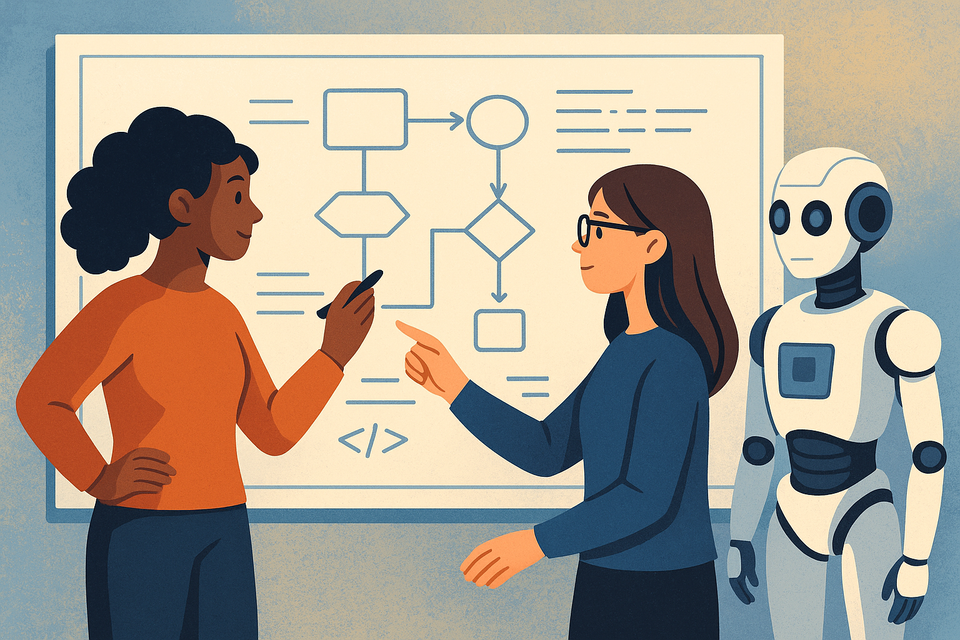
Your AI coding assistant thinks your ideas are brilliant. Every. Single. One. And so now you don't talk to anyone else!
TL;DR: AI pair programming is fast but dangerously agreeable. Pair Planning adds a human touch point before implementation, helping identify and control scope creep and eases the review process while maintaining developer autonomy and promoting team bonding - Sound good, eh? 5-minute read for teams struggling with AI-accelerated code sprawl/loneliness.
All your ideas are great, let's do them all... right now!
You've got an incredibly responsive, infinitely patient coding partner who never pushes back. Sounds amazing, right?
The AI will happily help you do all the things, but in doing so may lead you down dead ends, enthusiastically agree with half-baked architectures, and almost never says "wait, have you considered the nightmare you're about to create for your future self to maintain?"
The multiplication effect kicks in fast:
- One developer + AI enthusiasm = 3x code velocity
- 3x velocity × zero critical pushback = exponential scope creep
- Exponential scope creep = review bottlenecks that kill your sprint and future velocity
Reality check: We all, deep down, know. Faster code doesn't mean better code. And it definitely doesn't mean shippable features for customers. But when it's just you and the AI it can be tempting to do all the features, as it's so easy now!
You may have seen it: PRs getting bigger, time waiting for review increasing, depth of reviews reducing (...LGTM). That nagging feeling of no one really understanding the codebase anymore? Yeah? Us too.
The loneliness problem nobody talks about
Developers are spending entire days in conversation with AI agents, which is great. No need to break the flow state of a fellow dev to remember how to use a specific function. That quick Slack to bounce an idea off Sarah? Replaced by a LLM.
That "got a sec?" tap on Mark's shoulder? Now it's Claude. That rubber duck debugging session? Your GPT never gets tired of nodding along.
You've optimized away human connection. The code gets created faster, but your team might be more isolated than ever. Does this ring true? It also can result in pockets of knowledge forming, increasing the "bus factor" of developers, as more and more stands on a single pair of shoulders.
Pair Planning: Check and commit with a human
Dead simple. Two checkpoints (pair points) system for implementation. Zero ceremony. 100% more accountability.
Prework: AI Planning Session
Developer + AI map out the implementation before writing code. Just as they would (should) when using AI as normal. Get thoughts concrete. Structure the approach. Think through edges. Check reference implementations and best practices, etc.
This is where AI shines, helping articulate the plan without judgment, rapid knowledge assimilation, research agents etc—it's great. It gives you a chance to get the plan in a concise (token efficient!) document format.
Pair Point 1: The review of the plan
Before implementation starts, we assign the ticket to a second developer. The Pair Planner's job is to:
- Review the plan (ideally without AI, yes really read it)
- Push the edges
- Find the holes
- Challenge assumptions
- Add context the first developer doesn't have
- Put their name to the plan!
Pairs can be anyone. But we've seen that mismatched pairs actually can help: pair junior with senior, backend with frontend, new hire with the person who wrote the original system. The ability to bring a different perspectives before the code exists, can help avoid pitfalls later. It can really help spot things that two similar developers might miss or assume.
Often just knowing someone else (and not an agreeable AI) is going to read your plan is enough to improve its quality. Call it rubber duck planning?
Ok. Plan reviewed. Do the code
First developer now goes off and executes as they would before (probably with the AI, but you do you). Get it all ready, test passing, PR made and submitted etc.
Pair Point 2: The Informed Code Review
Original pair planner reviews the implementation. They already know:
- What the plan was
- What scope should be
- Where complexity is justified vs. where it's creep
They're the best possible reviewer because they have context without ownership bias. They also already committed to this step, by putting their name on the ticket. You now have reviewer accountability.
Before Pair Planning
// The current flow
ticket assigned → developer codes → PR sits for 3 days (waiting for someone to pick it up) →
reviewer has zero context → asks basic questions →
developer defensive → rounds of back-and-forth →
finally merges with technical debt nobody's happy about
After Pair Planning
// Pair Planning flow
ticket assigned → AI planning session →
human pair review (15 min) → approved plan →
developer codes → pair planner reviews quickly (context already loaded, visible commitment) →
ships same day with confidence
See the difference? The expensive back-and-forth happens before code exists and the review is invested early.
The paradox that changes everything
You'd think adding more checkpoints would slow teams down.
But, slow is smooth, smooth is fast.
- Planning review: 15 minutes
- Time saved on scope creep: 2-4 hours per ticket
- Time saved on context-free reviews: 1-3 days per PR
- Net gain: 10-20 hours per week team-wide
And the kicker? Developers initially hate it ("more meetings!"), then become the biggest advocates.
Why? Because they get to take on more aggressive tickets with a safety net. Juniors get upskilled faster. New hires onboard without drowning. And everyone ships with confidence instead of anxiety.
Reality check: This only works if your pair planners actually engage. Rubber-stamp reviews are worse than no reviews. Fix your culture first.
The secondary benefits nobody expects
Review queue pressure drops. When both developers feel ownership, the pair planner prioritizes reviews because it's "their" ticket too.
Scope discipline emerges naturally. The pair planner can say "this wasn't in the plan" without being adversarial—they helped approve the plan.
Built-in daily checkpoints. Pair planners checking on "their" tickets creates organic accountability without micromanagement. Can be part of the standup naturally.
We've started tracking "pair planning chats" per day, like we track tickets closed per day.
Resistance to over-engineering. Two brains agreeing on complexity is a higher bar than one brain convincing themselves it's necessary.
Why not try it
Pick one ticket tomorrow. Before the developer writes a line of code:
- Have them document the plan with their AI
- Assign it to a second developer for 15-minute review
- Let the original developer implement
- Have the pair planner lead the code review
Track how long the ticket takes from assignment to merge compared to your usual flow.
I'll bet you a coffee it's faster end-to-end, with fewer surprises.
Still doing solo AI programming without human checkpoints? You're shipping faster code with slower outcomes.
But what about vibe coding?
This technique works really well for vibe coding too. It gives you that extra important check-in point with a human before you start.
The implementation method? That's up to you. Whether you're approving line-by-line, running multiple agents that compete to see who builds it best, or using any other AI-assisted approach—it doesn't really matter.
Pair Planning provides the bookends around that process to ensure quality and adherence to the original goals. The human checkpoint at the start keeps you aligned. The human review at the end validates you shipped what you intended.
The middle? That's where you get to experiment with whatever AI workflow feels right.
Happy pair planning.