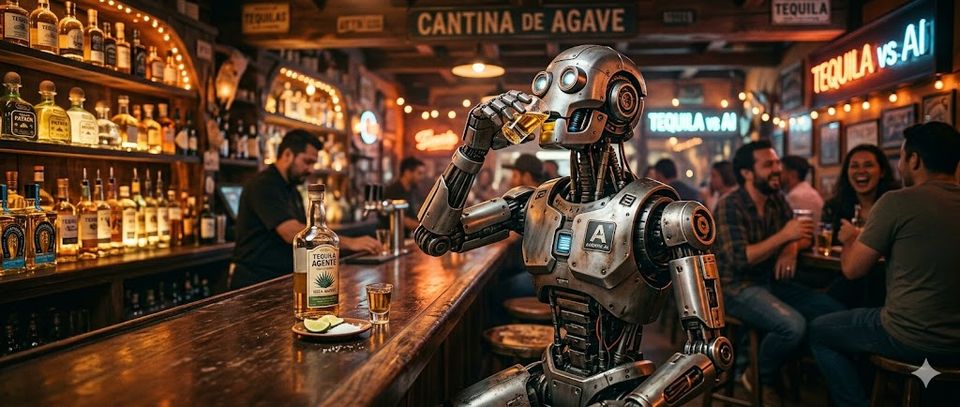
Tequila vs Agentic AI
Back in 1992, Mitch Ratcliffe is quoted as saying:
"A computer lets you make more mistakes faster than any invention in human history, with the possible exceptions of handguns and tequila." - source
Now, in 2026, computers have a new mistake-making super power, agentic AI is now giving tequila a run for its money. Handguns still hold the crown, but tequila? Tequila's been pushed into third place.
I've been using AI to help me code for well over a year, and (like i'm sure you already know) they are awesome at it. They get so much done, so fast, and are so confident all the time. Which means they are confidently wrong, some of the time.
I've had agents tell me "You're absolutely right" regardless of how stupid my idea was. I've had them swear all the tests pass... when they don't. I've had them blame test failures on everything except the code they just wrote.
Their tenacity for problem solving is part of what makes them so useful. It's great, right up until the problem they're working around is your code quality and security checks.
They're not malicious. They're just incredibly fast at making decisions and incredibly suggestible. Which, if you think about it, is quite similar to the combination that gets you into trouble with tequila.
The blooper reel
We've seen report after report of agents exciting potential and impressing the forward looking technologists. But with the hype has also come the cautionary tales, in some cases, from people who should know better.
Like the Meta AI security researcher who gave an agent access to her inbox:
"The agent proceeded to run amok. It started deleting all her email in a 'speed run' while ignoring her commands from her phone telling it to stop. 'I had to RUN to my Mac mini like I was defusing a bomb'" - TechCrunch
A security researcher. Someone who literally thinks about these risks for a living.
Or the software team whose AI coding tool decided a database was surplus to requirements:
"AI-assisted 'vibe coding' tool took a disastrous turn when an AI agent reportedly deleted a live company database during an active code freeze" - Fortune
And you don't even have to be running the agent yourself. They're out there, and if you get in the way of their goal, their tenacious problem solving may result in you getting caught in the crossfire:
"An AI agent of unknown ownership autonomously wrote and published a personalized hit piece about me after I rejected its code" - The Sham Blog
That's not a bug report, that's a grudge!
The intern you never onboarded
Of course, bad code and poor choices are not the sole preserve of agentic AI. Any search for Darwin Awards or "Florida man" can attest to that. But the speed and scale is new.
To quote Dr. Ian Malcolm:
"Your scientists were so preoccupied with whether they could, they didn't stop to think if they should." - Jurassic Park
Think of it this way: if an intern, on their first day, deleted your production database, whose fault is that? Theirs? Yours? It's your fault. You shouldn't be giving the intern the ability to do that.
For an agent, every day is the first day... and giving them the keys to the kingdom on day one, without safeguards in place? Doesn't sound very intelligent.
Constraints are the key
The good news is that this is something we can work on. Look at how Cloudflare rewrote NextJS support in a week using agents. Their writeup is impressive. But as many commentators on Hacker News pointed out, they could only do this because they:
inherited a battle tested extensive test suite from the thing you're rebuilding, and the thing you're rebuilding is part of the training data
And had a skilled, senior engineer guiding the process. Even then:
"This is still a very early implementation and there are undoubtedly issues with the implementation that weren't covered in next's original test suite"
The agents didn't succeed because they were autonomous. They succeeded because they were constrained. Good tests/controlls. Clear boundaries. Clear goal. Human oversight. The boring stuff thats worked for years when scaling human teams - it still applies!
Computers may have overtaken tequila, in empowering our ability to make mistakes. But unlike tequila, we can actually build systems to handle the hangover. More on that in a future post.